
24th September 2025
Edinburgh Institute of Diplomacy and Economics Briefing
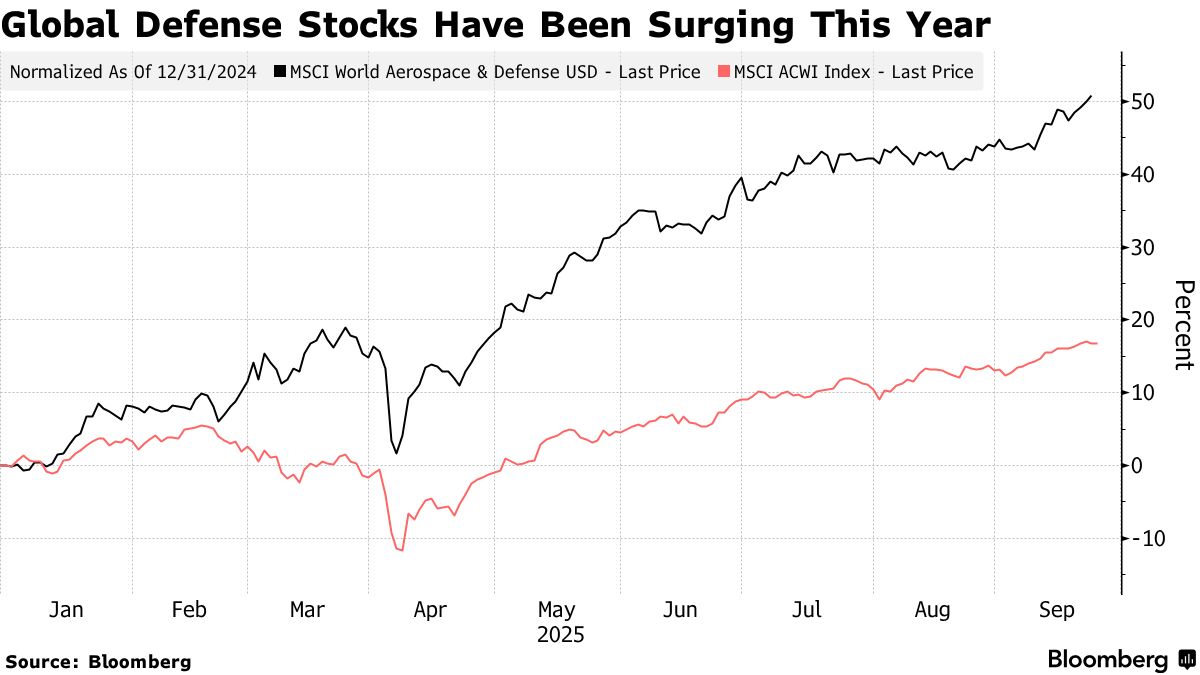
-Defence stock rally of Europe, South Korea and Japan following increasing security risk.
Safe assets likely to continue their surge.
Ukraine has been destroying Russia's air defence systems and intensifying drone attacks on oil and gas infrastructure within Russia.
Russia's territory is vast, necessitating a focus on defending the areas around President Putin.
Under sanctions, restoring air defence systems is no simple matter.
Domestic inflation is accelerating, and the central bank continues its high interest rate policy of nearly 20%.
Fearing domestic backlash over rising petrol prices and an economic slowdown, Russia is resorting to provocative actions towards NATO nations.
This reflects Putin's growing desperation.
Furthermore, in South Korea, following the detention of Korean workers in the US, President Lee Jae-myung, who espouses principles of self-reliance and independence, may adopt a hardline stance towards the US. (An expansion of the boycott movement against US goods is also anticipated.)
While the withdrawal of US forces from South Korea should be avoided from the perspective of maintaining the military balance in Northeast Asia, North Korea's provocative actions require close monitoring.
Amidst America's arbitrary, self-centred policies and worsening global security risks, defence stocks in Europe, Japan, and South Korea are rising.
Prime Minister Netanyahu's barbaric acts in the Middle East are also exerting upward pressure on WTI.
Combined with uncertainty over US policy and attacks on the Fed's independence, the rise in the price of gold as a safe-haven asset shows no sign of stopping.
With more than three years remaining in Trump's term, and given this momentum, a price rise over $4,500 seems only a matter of time.
Silver and platinum, as alternative investment outlets, are likely to follow suit and rise.
European nations must not fall into Putin's trap.
The NATO alliance, without America, should adhere to a resolute defence policy and commit fully to technical, military, and economic support for Ukraine.
Though an asymmetric conflict, Ukraine is gaining the upper hand in this new form of cyber warfare.
European nations should maintain deep deliberation and avoid falling for provocation.
The Putin regime could collapse under domestic discontent and Ukraine's counteroffensive from abroad.
However, Putin's final counterattack could involve nuclear strikes against Ukraine and Europe, necessitating preparations for catastrophic scenarios.
Next, let us examine Russia's international environment in greater detail.
Despite enduring economic and financial sanctions, Russia's wartime economy enabled sustained conflict.
The cause of restoring former superpower status also played a role.
Even when prices were not significantly different from international levels, major defectors like China and India continued purchasing Russia's scarce crude oil to maintain longstanding diplomatic ties. Transactions via shadow fleets also underpinned Russia's state finances.
In a multipolar world, neither Prime Minister Modi nor President Xi Jinping, both strong leaders, need feel compelled to yield to America's secondary sanctions.
Indeed, the emergence of external adversaries may prove advantageous for uniting their domestic populations.
The Trump administration's tariff policies, resembling interference in Brazil's domestic affairs, have diminished the legitimacy of American foreign policy.
Within this multipolar international order, including the turmoil in the Middle East, defectors need not fear ''political isolation,'' primary driver for producing success of economic sanctions.
China faces mounting domestic discontent due to its property market slump.
A fragmented global order facilitates the Communist Party regime in adopting external policies that divert domestic grievances.
Economically, to offset weak domestic demand, it is accelerating its export drive, intensifying deflationary exports to ASEAN.
ウクライナがロシアの防空システムを破壊しロシア国内の石油・ガスインフラ施設へのドローン攻撃を強めている。
ロシアの領土は広大であり、プーチン大統領周辺の防衛に徹する必要がある。
制裁を受けている状況で簡単に防空システムを復旧できるものでもない。
国内のインフレは加速し中央銀行も20%近い高金利政策を続ける。
ガソリン価格の上昇と経済が減速し始めたことで国内世論の反発を恐れNATO諸国への挑発行動を採っているのであろう。
これはプーチンの焦りの現れである。
また韓国では米国での韓国人労働者の収容所連行を受け自主独立の理念を持つ李在明大統領が対米強硬姿勢を採る可能性もある。(米国商品の不買運動の拡大も予測される。)
韓国から在韓米軍が撤退することは北東アジアの軍事バランスの維持の観点から回避すべきだが北朝鮮の挑発行動を注視する必要がある。
米国の恣意的かつ自国第一主義の政策に加え、世界的な安全保障リスクの悪化でヨーロッパや日韓の防衛株は上昇している。
中東でのネタニヤフ首相の蛮行もありWTIには上押し圧力がかかる。
アメリカの政策不透明感とFRBの独立性への攻撃も相まって安全資産の金価格の上昇も止まらないであろう。
トランプの在任期間はあと3年は残っておりこの勢いだと4500ドルを突破するのも時間の問題であろう。
資金の受け皿としての銀とプラチナも追随して上昇していくだろう。
ヨーロッパ諸国であるがプーチンの罠に嵌ってはならない。
アメリカ不在のNATO陣営は断固とした防衛政策とウクライナへの技術・軍事・経済支援に徹するべきだ。
非対称戦争だが新たな形のサイバー戦争でウクライナが優勢になっている。
ヨーロッパ諸国が深慮を保ち挑発に乗らなければプーチン政権は国内不満と国外のウクライナからの反撃により崩壊する可能性も出てきた。
ただプーチンの最期の反撃はウクライナ・欧州への核攻撃も想定され壊滅的な事態に備える必要があるであろう。
次にロシアを取り巻く国際環境をもう少し詳述する。
経済・金融制裁を受け続けていたものの戦時経済下での経済成長により継戦できていたのであろう。
かつての超大国の復活という大義もある。
国際価格とさほど変わらなくとも長年に渉る外交上の関係性を維持するために希少性がある原油は中国とインドという大口のDefectorが購入を続け、影の船団による取引もロシアの国家財政を支えてきた。
多極化しており強い指導者であるモディ首相も習近平国家主席もアメリカの二次制裁には屈する必要性はないだろう。
却って外敵ができて国内をまとめるには好都合であろう。
トランプ政権はブラジルへの内政干渉のような関税政策を振りかざし、アメリカ外交政策の正統性は低下している状況だ。
中東での混乱も含め多極化した国際体制においてはDefectorになっても政治的孤立感を感じることはない。
中国は国内の不動産不況で社会不満は高まっている。
世界の極体制が分断していたほうが共産党政権は国内の不満を発散させるような対外施策を採りやすい。
経済的にも内需不振を補うため輸出ドライブを加速させASEANへのデフレ輸出を加速化している。
(ASEAN諸国の産業競争力の低下が憂慮される。)
また一帯一路やAIIBを活用し米国に依存しない中華経済圏の強化を進める。
ロシアを同経済陣営に取り込むにも格好のタイミングである。