
16th Feb 2026
Edinburgh Institute of Diplomacy and Economics Briefings-Knowledge Series
-Both countries have been waning considering their Current Account Balance
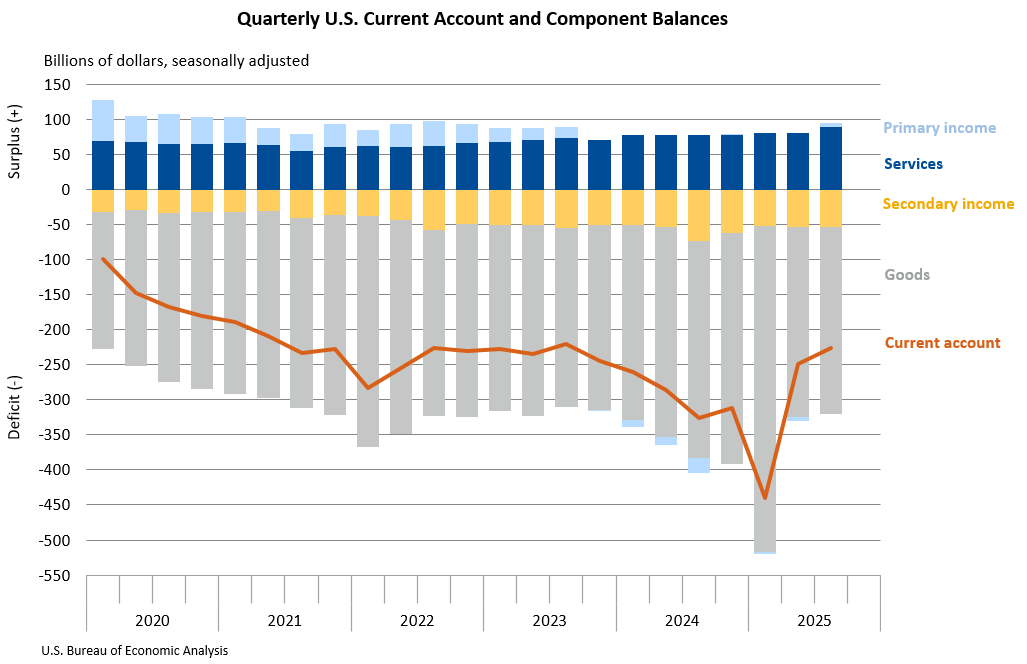
Breakdown of the U.S. current account balance
・Trade balance
Domestic demand expands due to the wealth effect on the affluent, increasing consumption.
・Primary income balance
High interest rates increase external interest payments, offsetting companies' earnings.
・Secondary income balance
Ukraine support
<US current account balance>
<Ref: BEA ‘’U.S. International Transactions, 3rd Quarter 2025’’
https://www.bea.gov/news/2026/us-international-transactions-3rd-quarter-2025>
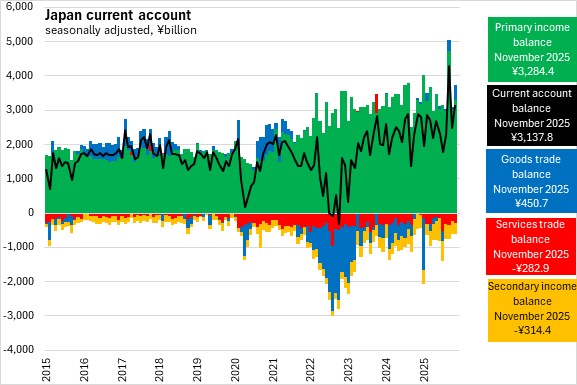
Japan's current account surplus is earned through the primary income balance.
Interest and dividend income from abroad significantly outweighs the trade deficit effect caused by structural yen weakness.
The services balance sees the ballooning digital services deficit offset by inbound tourism revenue.
Recently Japan's economy has been fragile.
This does not qualify as a healthy current account surplus.
<Japan’s current account balance>
<Ref: Nova Scotia Canada ‘’January 13, 2026
JAPAN CURRENT ACCOUNT AND TRADE BALANCE, NOVEMBER 2025’’
https://novascotia.ca/finance/statistics/archive_news.asp?id=21653&dg=&df=&dto=0&dti=3>
From a security perspective, superpowers tolerate current account deficits by providing international public goods and issuing reserve currencies.
This reflects the strength of their financial hegemony.
When they cannot tolerate deficits and resort to tariff policies, it signals their hegemony is waning.
Incidentally, Japan and the US coordinate on exchange rate policy, but without US authorities' approval, Japan cannot realistically intervene unilaterally.